It’s very easy to get confused about “what’s what” when you randomly see images or videos online regarding the elements of the Baalbek Temple site in Lebanon. Where is the site located? Where is the Trilithon located? Where are the other megalithic stones within the temple complex? Which is the Temple of Jupiter? Which is the Temple of Bacchus? Where are the cryptoporticos (subterranes) located, what is their layout and how to access them? Which is the Temple of Venus? Where was the Temple of Mercury? Where are the monolithic stones still left in the quarry? How far away from the temple site are they? What does the temple complex layout look like – originally as well as today?
Let’s begin to dispel the confusion . . . .
Location
The incredible temple complex is located in Baalbek, Lebanon, which resides in the Bekaa Valley roughly 90 km (56 miles) northeast of Beirut. It’s nestled between the Mount Lebanon range to the west and the Anti-Lebanon Mountains to the east.
It’s not exactly easy to get to compared to any of the numerous Roman cities on the coast of the Mediterranean, particularly when you have to transport 128 monolithic granite columns from Aswan, Egypt, down the Nile, over the sea, and finally over the mountains to Baalbek. I’ll get to that later.
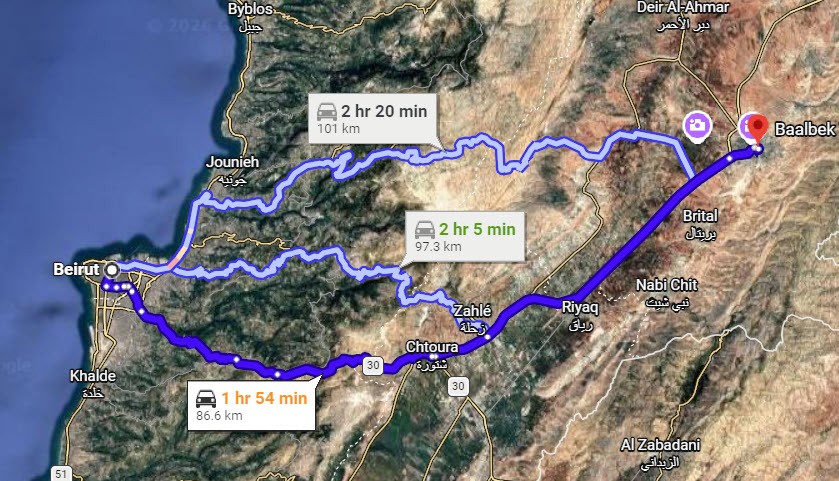
Layout & Components of the Complex
Let’s start with what will probably make the most sense with regards to grounding the mind as to the original layout of the complex. The image shown below is a reconstruction of how the temple complex most likely would have appeared in 3rd-century Roman times. I’ve noted the major components of the complex.
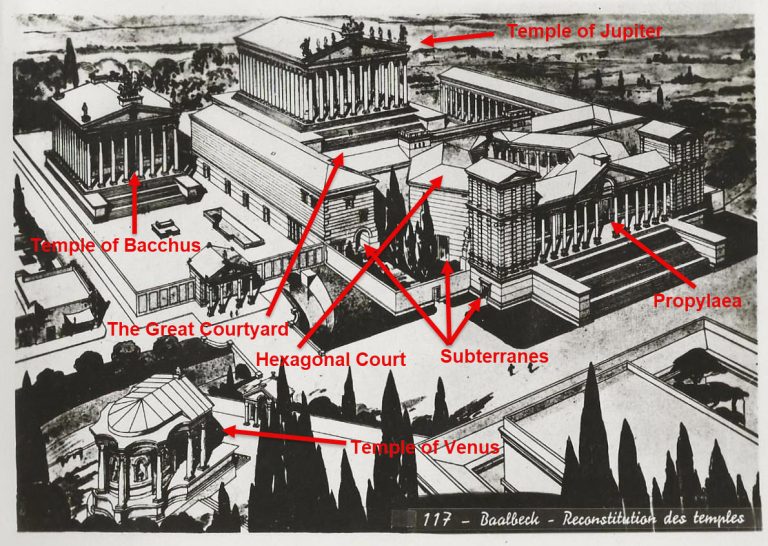
In this reconstruction noted above, a visitor to the sacred site in Roman times would enter up the steps of the Porpylaea – the monumental entrance to the complex.
From there they would pass through huge doors into the Hexagonal Court which was lined on all sides by column-supported areas known as porticoes (or colonnades).
From there they would pass through more huge doors into what is known as the Great Courtyard. This too was lined on three sides by column-supported porticoes. In the huge courtyard there are two ablution basins on either side of two sacrificial altars (one referred to as the Large Altar and the other the Small Altar).
From there they could climb the monolithic staircase to the entrance of the Temple of Jupiter – a monstrous temple 88 meters (289 feet) long and 48 meters (157 feet) wide. It originally stood with 54 massive Corinthian columns (about 20 meters or 65 feet tall), of which only six remain standing today.
Outside of that giant complex, next to it to the south is the Temple of Bacchus – widely considered the best-preserved and most intact large-scale Roman temple in existence. It measures approximately 66 meters (216 feet) long, 35 meters (115 feet) wide, and 31 meters (102 feet) high. Originally, it was encircled by a peristyle of 42 unfluted Corinthian columns, standing nearly 20 meters (66 feet) tall, with 15 columns along each side and 8 at each end.
Just east of that is the artistically attractive Temple of Venus – not as massive as the prior two, but beautiful in its own right, and containing a few megalithic stones itself. (the Temple of the Muses is no longer extant).
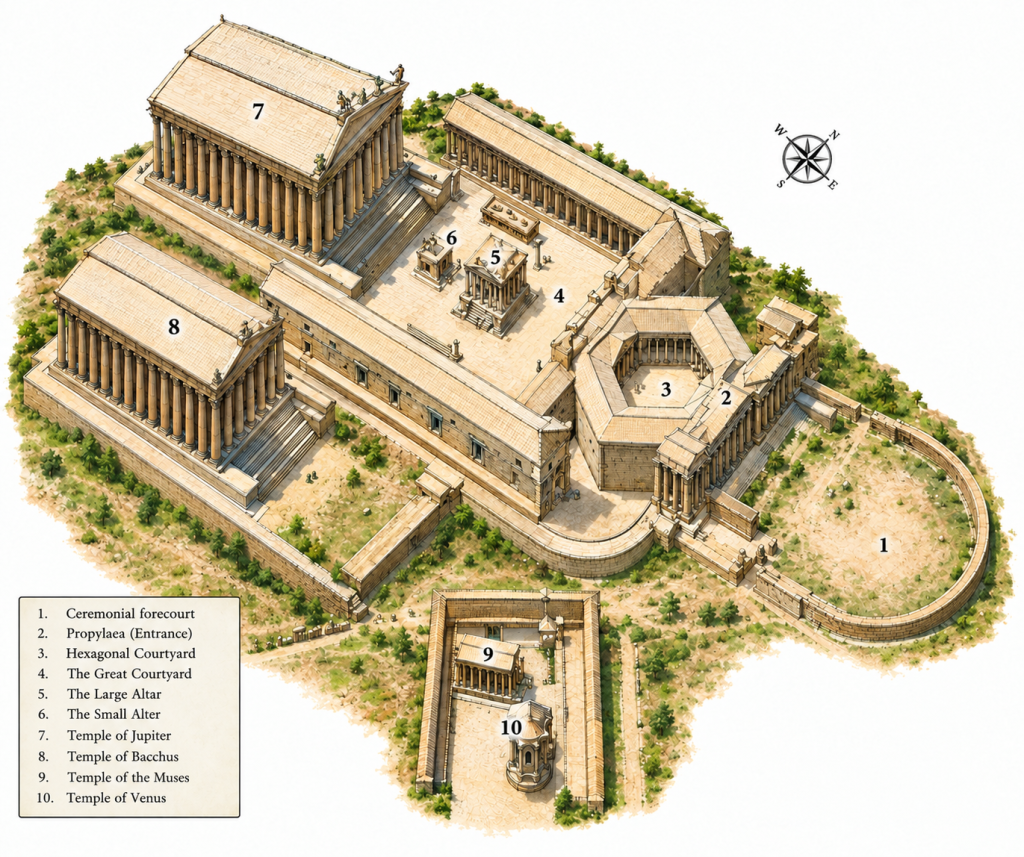
Here’s another layout diagram (via ChatGPT). Note the compass directions. They will be referenced later when describing where certain specific features are located.
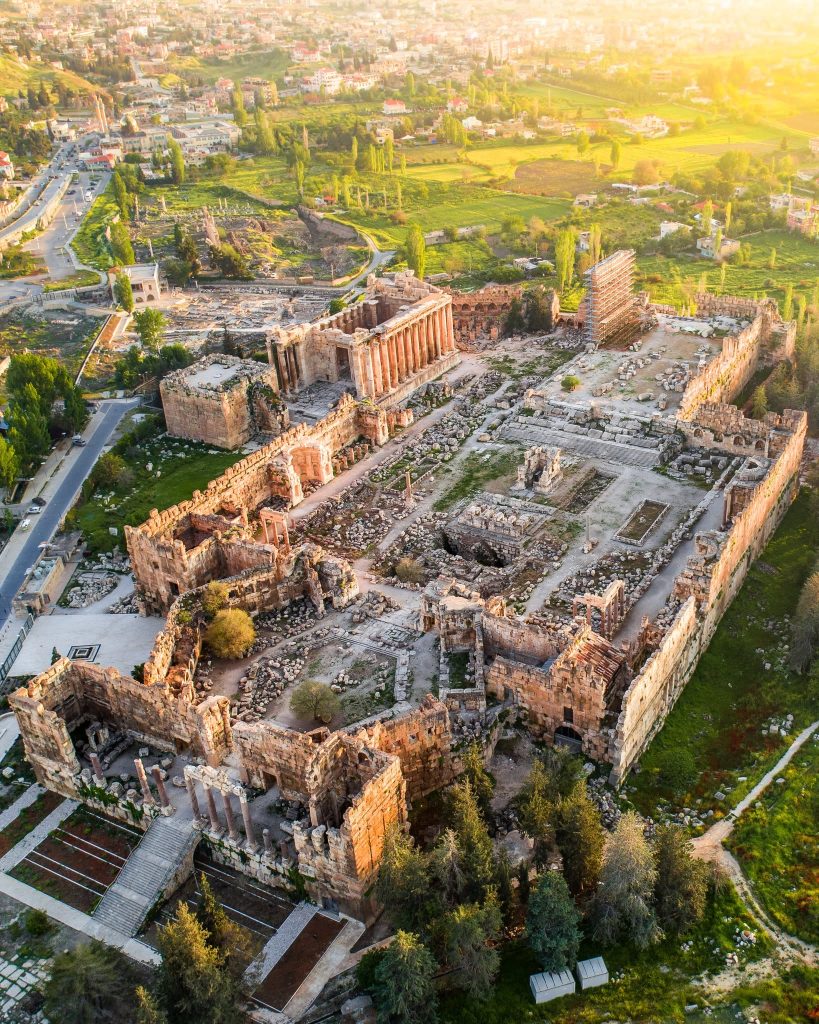
Quite a place, right? Rome built theaters, coliseums, aqueducts and other structures all over the “known” world during the span of their empire.
But did they build anything SO in-your-face monolithic/megalithic as this elsewhere? Were the blocks used in their other constructions normally 300 to 800 tons? Did they perhaps “inherit” some of the complex from an older unfinished or destroyed temple?
Orthodox academia (for the most part) says “no.” Let’s find out more, shall we?
🙂
Proceed to Part 3 (upcoming)
Go back to Part 1
Featured Image – Baalbek Temple Complex Ruins, looking to the South. West is to the right. East is to the left.
Sources:
- Ragette, Friedrich Baalbek. Park Ridge, New Jersey: Noyes Press, 1980.
Fair Use Notice:
– In good faith, this work contains fair use of copyrighted and non-copyrighted images from the public domain & the web for non-commercial & nonprofit educational purposes.
– This work is distributed free of charge.
– The author has neither monetized this work nor sought any profit from its distribution.
– Copyright disclaimer under section 107 of the copyright act 1976: Allowance is made for “Fair Use” for purposes such as criticism, comment, news reporting, teaching, scholarship, and research. Fair use is a use permitted by copyright statutes that might otherwise be infringing. Non-profit, educational or personal use tips the balance in favor of fair use.
– This work contains original work of commentary, education and critical analysis.
