As we research and assess the mystery of the astonishing megalithic architecture and sculpture of the ancients, we can’t help but reflect on the processes that resulted in the stone ‘s final appearance, location and use.
- How were the stones quarried?
- What methods were used to cut and free them from the earth?
- What tools were used in the quarrying process?
- What materials could (or couldn’t) cut the desired type of stone from the bedrock?
- How were the behemoths extracted from the quarry?
- How were they transported to the job site?
- How were they carved (dressed) to final shape – and when? after their extraction? at the construction site? some of both?
Legitimate (and very real) engineering logistics cannot be ignored or glossed over simply due to ignorance and academic fantasies. Theories are proposed and debated by the geological and archaeological academicians. How solid are those theories? What evidence are they based on? Has experimentation been performed to support the theories?
My intent is to present the academic theories of ancient quarrying and, where appropriate, point out any strengths and deficiencies in those theories. I’ll also present modern quarrying methods as a comparison – and in some instances to note certain limitations modern methods are faced with that ancient quarriers, stone masons, and engineers apparently conquered/surpassed.
I will be focusing exclusively on the quarrying of stones for architectural building and statuary. I will not be addressing quarrying/mining of precious jewels, metal ore, etc.
It must be noted that most academic research and publications related to ancient quarrying focus upon Egypt – with some also looking at European/Mediterranean and Incan examples. This is primarily due to the sheer volume of stone structures built by the Egyptians over thousands of years – leaving behind many examples of quarries used for a variety of types of stone. Therefore, much of the evidence and research presented will, by default, predominantly be about Egypt.
Ancient Quarries
Types of Quarries
When discussing ancient quarries there are two major classifications, each requiring different approaches, methods and tools to remove the stone:
- Soft stone (aka Softstone)
- Hard stone (aka Hardstone)
Soft stone quarries include Limestone, Sandstone (softer varieties), Gypsum, Soapstone (Steatite), Travertine, Calcite (Egyptian Alabaster), Anhydrite, Serpentine & Marble.
Hard stone quarries include Granodiorite, Andesite, Diorite, Gabbro, Gneiss, Dolerite, Granite, Silicified Sandstone (Quartzite) & Basalt.
The softness or hardness of stones is measured on the Mohs scale. An explanation of that as well as a table of comparative materials and their hardness can be found here. As that reference page notes, materials that are soft cannot cut/sculpt materials that are harder. The only exception would be using a process of abrasion wherein a softer material uses quartz sand to slowly abrade (wear away) a harder material through a process of continued rubbing.
Across soft stone & hard stone quarries you find the following approaches for cutting out and extracting the stone:
- Open quarries – situated completely out in the open air, cutting stones from the bedrock surface. Used for both soft and hard stones.
- Gallery quarries – situated underground, cutting and extracting stone from beneath the surface, creating man-made caverns (usually because the surface stone above has poor quality). Unquarried rock pillars were left to support the roofs. This approach was used only for soft stones such as limestone and travertine. These underground quarries could easily penetrate over 300 feet into hillsides.
Trenching
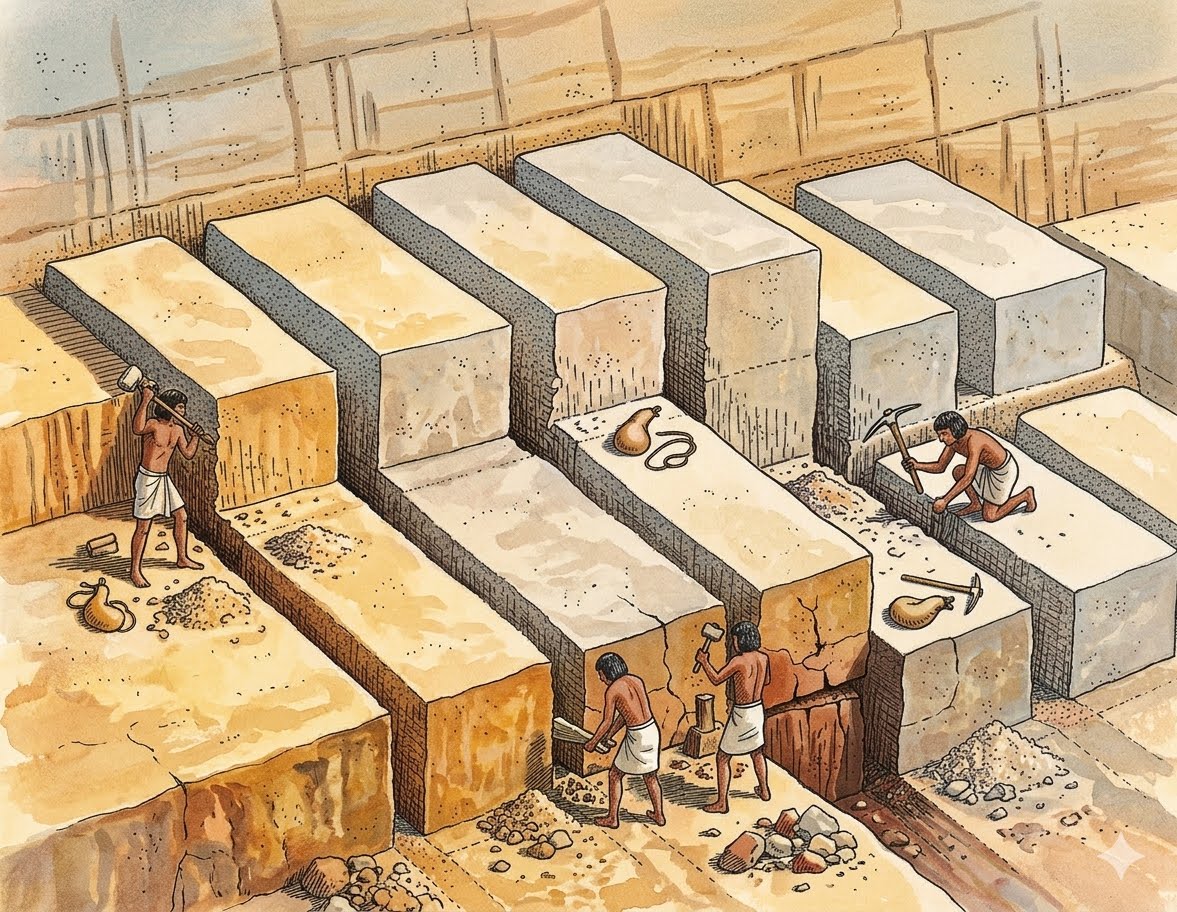
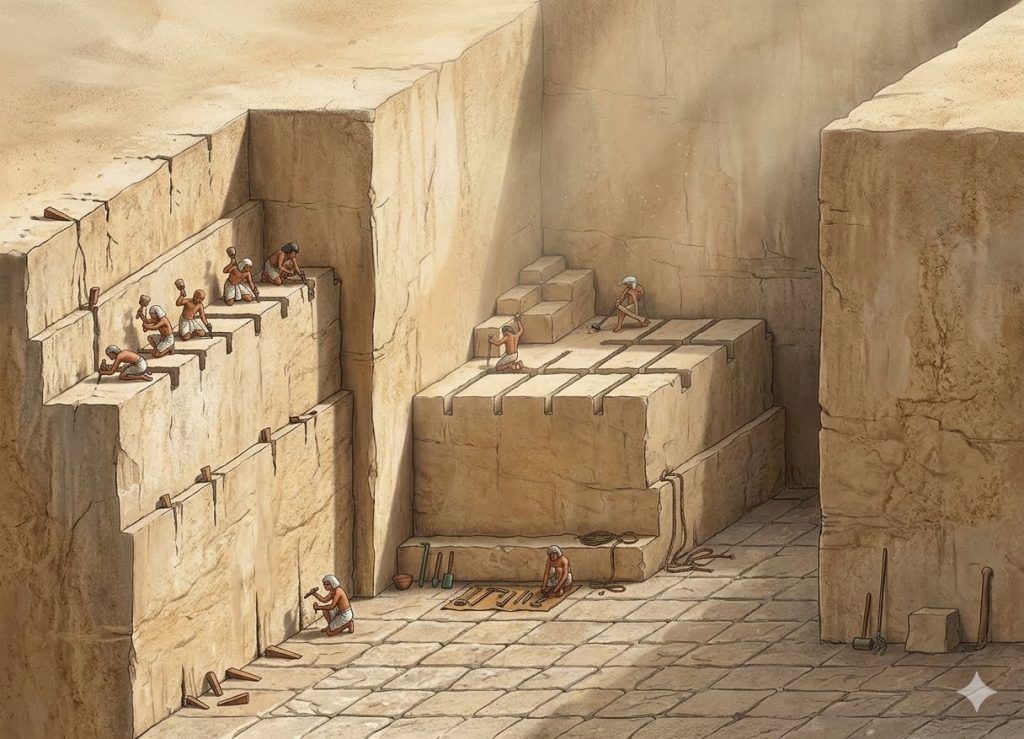
Archaeologists believe very early quarrying involved a low-volume approach wherein loose boulders on the surface would be acquired for the needed stones. As time and greater construction needs unfolded, a more systematic method was used commonly known as the ‘trench’ method. A trench is chiseled out from around three or four sides of what will become a block. The block is detached at the bottom by way of chisels, pounders, wedges, pry bars, and/or undercutting. Then the block is extracted and transported to a nearby construction site or (in the case of Egypt) to a barge in the Nile for delivery. It’s believed that the trenching method was invented in the Near East with the introduction of stone architecture about 4500 BC and spread later throughout the known world.
Trenching resulted in an increase in the output of large quantities of regular-sized blocks needed for pyramid and temple construction. As time went on and large building needs continued to expand, a more efficient trenching methodology was used from the New Kingdom forward in open quarries, called descending platforms. A large layer of the quarry was trenched for many stones. Then each block was separated at the bottom and pushed off the platform to land softly in a pile of quarry debris below. This approach resulted in a large, slowly descending surface with the removal of each layer.
Tools
Cutting Tools: The first thing to understand is that in order to cut stone you must have tools that are harder than the stone to be cut. Most orthodox theories regarding the tools used in the earliest quarries claim that copper chisels were first used. Later the quarrymen moved on to using harder bronze, and much later iron (perhaps eventually carburizing it to create steel – a harder material). The adoption and adaptation over time was driven by the discovery and development of ore extraction and metallurgy for the specific civilization.
Until recently, nearly all theories assumed metal tools were used. It’s now understood that in some instances, stone tools were more efficient – particularly on very hard stones. A cursory assumption would be that metal tools would cut any stone, however that simply isn’t the case. To reiterate, it comes down to the limitation that to cut a stone, you must use a material harder than that given stone. Copper and bronze can cut softer stones, but not harder stones. More on that below.
Separating Tools: To remove the trenched blocks it required methods that involved detaching the bottom of the block from the bedrock below it. Removing softer types of stone involved driving chisels or wedges in a line along the bottom to create a fissure, thereby dislodging or splitting it off. Larger and harder stone blocks had to be undercut and then dislodged or split off using large levers. Some theories claim large wooden wedges were inserted into chiseled wedge holes along the bottom of the stone, then wetted to expand and split off the ston. More current research, however, now questions this theory, particularly when the surviving wedge holes in quarries show they are not the right size for wooden wedges to work.
Dating
When available, quarries are dated using inscriptions or discarded relics within to indicate what pharaoh/leader ordered the work, or nearby temples built using the same material. The other method of dating is based on tool marks left on quarry walls. The theory for this dating method was developed by Rosemarie & Dietrich D. Klemm in their book “Steine und Steinbrüche im alten Ägypten” (Stones and Quarries in Ancient Egypt) – 1993.
The Klemm’s dating chronology theory is as follows:
- Short irregularly spaced, haphazard, multi-directional tool tracks = short, relatively soft copper chisels (Old & Middle Kingdom in Egypt)
- Slightly longer, more regular tool tracks (typically a herringbone pattern due to alternating work direction) = harder bronze chisels (Early New Kingdom in Egypt)
- Long, regular, nearly parallel, unidirectional, more closely and uniformly spaced tracks = introduction of longer bronze chisels (New Kingdom to Late Period (19th Dynasty on) in Egypt)
- Regular, parallel, long tool tracks = harder iron chisels (Ptolemaic & Roman Period in Egypt)
[Note: Reference this page for generally accepted date spans for Egyptian dynasties]
As popular as the Klemm’s dating chronology has become, it is not totally accepted by all geologists/archaeologists. Critics of the Klemms theory mention the following [Harrell & Storemyr 2013]:
- The Klemms assumed all marks left in all periods were made by chisels.
- They don’t provide diagnostic/representative lengths for the tracks, examples of which can vary from 2 in [5 cm] up to over 39 in [1 m] over time.
- Harrel & Storemyr agree that chisels became longer, but also note that bronze chisels were actually introduced earlier in the Middle Kingdom and iron chisels during the Late Period.
- They also note that the Klemms overlooked the clear evidence of pick-like tools used in Graeco-Roman times.
- And finally, the simple change in a chisel’s metal can’t explain the radical transformation in tool mark patterns. They believe these changes resulted from a change in the method of quarrying.
“How do you know this is an Old Kingdom quarry?”
“Due to the short irregular tool tracks on the walls, indicating short copper chisels were being used.”
“How do you know it was short copper chisels?”
“Because that’s what they used in the Old Kingdom.”
“How do you know they used those in the Old Kingdom?”
“Because of the short irregular tool tracks on the walls.”
Indeed.
🙂
Keep this in mind as you read further . . .
Most all of the theories noted in this article, and in academic literature – as convinced as their proponents may be – are in the end, just educated assumptions and suppositions informed by the only visual evidence available. Also, while sometimes demonstrated on small blocks, the methods/techniques have not been empirically demonstrated using the theorized tools on any stones of larger size. In fact, various efforts during the 20th-century to build small versions of pyramids or cut and raise obelisks using the orthodox theories have ALL defaulted to using modern machinery to quarry, lift, transport, dress and place the stone objects. More details of these attempts in future articles.
Let’s get in to some details regarding Soft stone and Hard stone quarrying, shall we?
“It is a great pity that no ‘learned society’ sends out a qualified person to make a complete study of the ancient quarries. The reason for this neglect appears to be that such a study would not be likely to furnish objects of interest to museums, to the securing of which new information is too often a secondary consideration.” [Clarke & Engelbach – 1930/1990)
Methods: Soft stone
As already mentioned, soft stones include: Limestone, Sandstone (softer varieties), Gypsum, Soapstone (Steatite), Travertine, Calcite (Egyptian Alabaster), Anhydrite, Serpentine & Marble. Limestone and sandstone dominated Egyptian architecture: limestone used from early Dynastic Egypt and sandstone from the Late Middle Kingdom onward.
Soft stones were quarried via both open and gallery type quarries, using the trenching method as described above. According to Harrell & Storemyr (2013), there are currently 89 known ancient quarries for limestone and another 36 for sandstone in Egypt.
Tools & Methods:
It’s theorized that the earliest ancient quarrying in soft stone was accomplished using the following tools:
- Copper chisels (flat or punch chisels – perhaps hardened) struck with wooden mallets to cut the trenches. Those were under 10 inches prior to the New Kingdom, but exceeded 20 inches beginning in the 18th Dynasty
- Later, bronze chisels and perhaps the use of picks
- Much later iron chisels and picks from the Late Period forward
- To split off the trenched block: chisels and wedges (wood or copper – later bronze and iron) or complete undercutting for very large blocks
Trenching Tools
Chisels were made from metal bars that were rectangular or circular in cross-section with the cutting ends tapering to either a point or a wide, flat edge. These were struck with a wooden mallet. They were typically 6 to 10 inches in length prior to New Kingdom and subsequently often over 20 inches in length. Chisels leave distinctive marks on quarry walls – segmented grooves where each segment is usually less than an inch, representing a single strike of the mallet. The grooves are very narrow when cut with a pointed chisel, and wider when cut with a flat-edged chisel.
I previously mentioned the absence of picks from the Klemm’s tool-dating chronology. In soft stone quarries, Somers Clarke & Reginald Engelbach, as well as Dieter Arnold all feel that the Old & Middle Kingdom used pickaxes held by both hands which left curved tool tracks. Per Storemyr is particularly a supporter of the pickaxe theory. Pickaxes later became the standard tool for cutting trenches in soft stone and marble elsewhere in the Graeco-Roman world (Minoans on Crete, for example). It’s difficult to imagine that the Egyptians would not also adopt them during the Ptolemaic and Roman periods instead of the long chisel. Pickaxes would have had a narrow blade which leaves strongly parallel, curved tracks 4 inches or more in length. Another potential tool available was perhaps an adze – a flat metal blade made of copper or bronze, lashed to the end of a curved wooden handle.
As an alternative to metal, picks of hard stone have been suggested especially chert or flint used to quarry or dress limestone and sandstone. Mounted at the end of a wooden handle, swung in an arc, may have produced the somewhat “curved” tool tracks commonly seen in Old and Middle Kingdom quarries. However, fragments of stone picks have not been found in the debris below the walls of limestone and sandstone quarries.
In Minoan Crete (same time period as New Kingdom Egypt) – socketed bronze axe-adzes, pick-axes, double-adzes and hammers were employed. Egyptians must have been aware of these other bronze tools but there is no evidence they adopted them for quarrying.
The only known metal chisels suitable for working in stone (the round bar chisels) are not pointed, however, but show a flat, wide cutting edge. They were used for cutting the walls of rock tombs – leaving typical wide, band-like marks
One would assume that pointed stone picks or axes were used during the Old and Middle Kingdoms. The type of tool used in the New Kingdom on, however, has still to be found. [Arnold 1991]
Trenches were narrow in order to extract smaller stones, but had to be wider for large blocks in order to accommodate the bodies of workmen who were cutting with chisels and to allow complete undercutting.
In a sandstone quarry near Gebel el-Silsila there are trenches 2.5 to 3.5 inches wide at the top and taper as they go down up to 16 inches. Continuous chisel marks run from the top to bottom on the sides of the trenches. The trenches are too narrow to accommodate a hand holding chisel or the mallet used to strike it, so the thought is that they must have been cut with a long, narrow chisel. Similar narrow trenches are seen in many other quarries and must of been cut with the same kind of tool.
Separation Tools
A softstone block was assumed to be separated from the rest of the bedrock by either chiseling, wedging or by undercutting. Small block separation would use chisels and wedges to split it off the bedrock. It is unclear if separation was done with multiple chisels along a line or one chisel was pounded in at numerous closely spaced points along this line. It is also unclear if it was the same tool/chisel used to cut the trenches, or perhaps a shorter chisel or even a small wedge. The hammering of chisels or wedges under the block induced a fracture. With skill, it could be confined to a relatively horizontal plane.
Much larger blocks required a very wide trench (for a human to work in) and nearly 100% undercutting, at some point loose pieces of stone or wood would be inserted beneath the large block before the last connections to the bedrock are cut away, or huge wooden prybars used to snap it off its remaining supports. An example of this is the unfinished Colossi in the New Kingdom Sultan Pasha limestone quarry near el-Minya.
Wooden wedges have been found in Roman quarries, but none found in Greek quarries. Wooden wedge holes cut with a chisel can be differentiated from the iron wedge-holes by their wide spacing and very large dimensions.
According to Arnold, Joseph Roder showed that wedges and fins were not used before Ptolemaic quarrying, one has to assume the blocks were pried out of their bed with the help of wooden levers. Also, Reisner assumed that wooden beams a little over 6 inches square [16 x 16 cm] in section were put into long rectangular excisions near the bottom of the trench and the trench was watered so that the swollen wood could have done the lifting [splitting].
Gallery quarrying details:
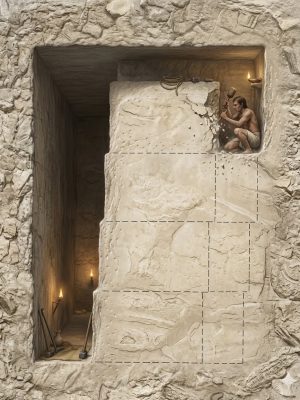
To trench and quarry blocks from a Gallery quarry (aka Covered quarry) required a more complex process:
- A horizontal slot was cut along or just below the ceiling at the top of the quarry face, as far back as necessary to allow a worker to get behind what would be a new series of blocks. (see the diagram above)
- A worker crouching in this space would then cut vertical separation trenches along the back and sides.
- Quarrymen then removed blocks progressively downward to the gallery floor.
- In essence, a different form of descending platform approach.
- Stone chips and debris softened the stone’s fall after its bottom was split off the bedrock and the block pushed off forward.
- Quarry walls have a slight stepped face.
These limestone galleries commonly penetrated over 300 feet and at times as much as 800 feet into the hillside.
Experiments
Experiments conducted by Denys Stocks showed that “even calcite, a relatively soft stone of hardness Mohs 3-4, cannot efficiently be cut with copper alloy tools” [Stocks 2003]. He produced by ancient casting methods bronze chisels of 3 to 15% tin and different grades of hardness that he achieved by cold hammering in the range of VPN (Vickers Pyramid Number) 132-247 hardness. He used the chisels on nine different Egyptian stones, from soft sandstone to the hardest granodiorite. The result was that he could cut red sandstone with ease, soft limestone with infrequent sharpening of tools, and alabaster (calcite) with frequent sharpening of the tool. The harder variations of limestone and sandstone – not to mention the still harder stones – immediately ruined the tools. Stocks concluded that these stones could be cut and dressed only with stone tools and that the use of metal tools, at least until the introduction of iron at the very end of Pharaonic stone building, was much less frequent than had been thought.
It is likely that chert pick heads were commonly employed. “Although copper and the harder bronze were tough enough to work softer stones, these tools were quickly blunted and abraded. They are entirely unsuited for quarrying the hard stones, for which the stone tools were much superior.”
Now let’s take a look at hard stone quarrying and how it differed from soft stone methods.
Methods: Hard stone
As already mentioned, hard stones include: Granodiorite, Andesite, Diorite, Gabbro, Gneiss, Dolerite, Granite, Silicified Sandstone (Quartzite) & Basalt. These stones were cut out in open quarries using the trench method. Granite was used as a building material in Egypt and by the 18th and 19th Dynasties had become the third most used stone after limestone and sandstone. Andesite and granite were the primary stones used in South America (Inca). During those Egyptian dynasties, a very large number of huge obelisks and colossal statues were produced in granite and quartzite. According to Arnold [1991], of the hard stone quarries only granite ones have been sufficiently studied – and some analysis has been published on quartzite quarries.
Tools & Methods:
Theories for the tools used in ancient quarrying of hard stone include the following:
- Copper or bronze chisels and picks. Some academics still insist these materials were used for hard stone quarrying before the period that iron was discovered and developed. However, they seemingly ignore (or unaware of) the experimental evidence that shows the impossibility of such a proposal. One academic author even quipped that certainly, with the application of advanced skill, copper or bronze tools must have been used.
- Stone chisels, picks, tools that are harder than the stone intended to be cut, such as: pounding balls made of dolerite (diabase), as well as chisels or picks made of the same, or from chert or flint.
- Iron chisels, picks and wedges much later. Although the hardness of ancient iron (Mohs value less than 5) or early low-grade steel (Mohs value less than 6) would also not be up to that task of cutting stones that have a Mohs hardness of 6 to 8.
- Wooden wedges and levers
Trenching Tools:
The reality of engineering and materials science says that only metal tools of very hardened steel can cut the hard stones (tungsten steel, tungsten carbide steel, chromium steel) which we are told couldn’t have existed at the time. Their development didn’t occur until about 1850 or later.
So, if it wasn’t metal tools, what was it? The general consensus is that it had to have been stone tools – stone as hard or harder than the rock to be cut. Very hard stones such as those noted immediately above. Types of tools would have included pounding balls, chisels, punches, pickaxes, adzes, and mauls all made from extremely hard stone.
Pounding Balls
It was Reginald Engelbach who, while researching the Great Unfinished Obelisk in Aswan, Egypt, recognized the method used for trenching in granite quarries: so-called pounding – bruising off small flakes of granite by bringing down rhythmic and regular bounces of roundish dolerite balls. Dolerite balls were found at the site (Aswan), and they left clear marks on the stone itself, completely different from those those of stone picks.
Dolerite (diabase) seemed to be the most popular pounding ball material – a very tough greenish stone. It was supposedly available throughout Egypt, although I’ve never seen any explanations as to how it was formed in nature. Other possible pounding ball materials included fine-grained granite, silicified sandstone (quartzite) or anorthosite gneiss. Pounders were used to hack out trenches and undercuts. It’s thought that fire-setting was occasionally employed (with or without water quenching) to induce fracturing or weaken the stone’s surfaces prior to pounding.
Specifics of Engelbach’s theory based on observations at the Unfinished Obelisk in Aswan, Eygpt:
A separating trench had to be dug about 30 inches wide [75 cm = 10 palms] and divided into working sections 24 inches long [60 cm], the minimum space for a kneeling worker. One working section was divided into four quadrants, which indicate that the worker assumed four positions. Kneeling in one quadrant and working in the opposite one while his basket and reserve tools were stored in the free squares. From time to time, he changed position in order to relax his knees and to produce level surfaces. The slightly sunken quadrants are about 12 inches square [30 x 30 cm]. The dolerite pounding balls vary from 5 to 12 inches in diameter and weigh an average of 12 pounds. It is known that a dolerite pounding tool was sometimes attached to a haft, since a piece of dolerite of the XI Dynasty has actually been discovered, bound by leather thongs on to two pieces of wood. Thus there would always be one foot between a man and his neighbors. Engelbach claimed that a “more efficient method could hardly be imagined.“
The effect of such a system of work would be to leave the sides of the trench in the form of corrugations (which appear as “scoop marks”). The same appearance is also seen in the quarry face above the Aswan obelisk from in front of which another monument of considerable size has been removed.
In Peru, the Incas (the claimed builders of their incredible stone walls) supposedly did not have the use of iron tools nor the wheel, and it is assumed that they selected rocks from rock falls or broken from a rock face by a pry-bar. [Protzen 1985] Yet Protzen cannot find documentation that any prybars of any material have ever been found. Like in Egypt, it’s claimed they used hammerstones (pounding balls) to quarry and finish their hard stones – andesite and red granite – “with little effort and in short time.” Red granite was used at Ollantaytambo. Andesite was used for the construction of Cuzco. Protzen performed his own experiments in the quarries but only using moderately small stones. To my knowledge, no experiments have ever been conducted to replicate the use of extremely large, cyclopean blocks or those with extremely harsh angle joints, mortarless, zero-gap fittings to prove that his theories are correct.
The Kachiqhata quarry (red granite) was used for blocks of stone at Ollantaytambo. Remarkably, it lies on the other side of the Urubamba River about 2.5 miles [4 km] to the southwest and between 2,300 – 3,000 feet [700 to 900 m] above the valley floor. The quarried stones would have to be moved down the slope of the mountain to the river via slide ramps, across the river, and back up the mountain on the other side to their intended destination at the Ollantaytambo complex. Along this route there are about 80 abandoned stones intended for the complex. There’s no explanation as to why they were abandoned, while others made it to their destination. Protzen reports that the “roads” to the Ollantaytambo complex are have “gentle” inclinations of 8 to 12-degress slope. [gentle? LOL] The longest ramp slide from the quarry had an impressive drop of 820feet [250 meters] down a slope of 40-degrees, where some of the abandoned blocks lay.
The other known Incan quarry is Rumiqolqa (andesite) used in the construction of Cuzco. It’ located an incredible 22 miles [35 kilometers] southeast of Cuzco on the left bank of the river Vilcanota, just off the Inca highway leading from Cuzco to the Qollasuyu. To quote Protzen “The choice of a particular rock type must have been of utmost importance to the Incas, or they would not have quarried sites so difficult to access and so far away.“
Stone Chisels & Picks
The trenching of quartzite [silicified sandstone] in the quarries of Gebel el-Ahmer, Gebelein and Aswan seems to have used a method that differed from pounding balls. The extreme hardness of some of its varieties necessitated a technique not used in the quarrying of granite.
The quartzite separating trench method shows certain differences from that used for granite. The method of making a separating trench in quartzite seems to have been as follows: a line of holes, as close together as possible and about two inches in depth, was made with a blunt-pointed tool [perhaps dolerite?] along what were to be two walls of the trench, and another line of holes was made midway between them. These line of holes became miniature separating trenches, leaving two ridges of rock between them, which it’s thought were then jarred off by blows with dolerite pounders, and the process repeated.
Iron
Sometime by the 26th to 30th Dynasty in Egypt (the Late Period) it’s thought that “iron” may have been used for quarrying tools.
Perhaps at some point the trench pounding technique using pounding balls was replaced by using iron punches [Waelkens, De Paepe, Moens, 1990]. Yet according to the Mohs scale, early iron cannot cut granite or quartzite (Mohs scale 4 to 5 for iron versus 6-8 for granite & quartzite).
Copper/Bronze
By now, it should be obvious that copper and bronze were unsuitable for quarrying hardstones. So, why am I bothering to list it as a tool material for hard stone quarrying? Well, per Clarke & Engelbach, “an examination of the hard rock quarries shows clearly that a pointed tool, most probably of metal, was used in cutting them, and it is likely that it was some form of mason’s pick.” Some academics find it impossible to let go of the impossible.
To quote them: “With what success, however, the hard rocks could be cut with a copper pick is a matter of speculation, and might well be tried by a person accustomed to using this tool, since skill plays a very great part in such work, and a practised workman might obtain results which could not be obtained by an amateur.” So, apparently “skill” must be the magic bullet used to defy the reality of materials/engineering science and geological science. Wow
Separation Tools
Undercutting & Levers
What is undercutting? It’s when a person lies on their back and side hacking at the stone below the block intended to be extracted. It’s the method used when stones are so large that the use of small chisels and wedges to break it loose from the bedrock would be fruitless. There are two main methods used:
Partial undercutting: This proposal states that the undercutting was made from all sides of the trench, but not entirely through-and-through, thus leaving a spine that the intended block still rests on and connected to the bedrock. Then extremely large wooden levers/beams were inserted along the side trenches and pried in order to snap the stone off the bedrock.
Complete undercutting: This proposal states that the undercutting proceeds as in the partial method above, but then workers place miscellaneous loose stones beneath the huge block to hold it up while they completely hack out the entire bedrock spine connecting it to the earth.
Per Arnold [1991], since it would have been too difficult to lift an obelisk out of its quarry hole [pit], the front of the hole had to be opened as well so that the block could be levered or pushed out more easily and rolled down over it’s long sides to the transport ramp.
Wedges
At one time, it’s thought that wooden wedges (soaked to swelling with water) could be used for splitting off hard stones from the bedrock, since copper and bronze wedges would be destroyed if hammered into granite. However, this theory has been abandoned and declared a “fiction.” In reality, this cannot work for the sizes and shapes, spacings, and often inclined orientations of wedge holes found in ancient Egyptian hard stone quarries. For a long time Egyptologists believed granite was quarried with the help of wooden wedges inserted into wedge holes since long chains of wedge holes could still be seen in the quarries of Aswan, This theory was abandoned for two reasons: 1) Joseph Roder showed that no such wedge holes could be dated before 500 BC [Arnold 1991], 2) Wooden wedges, after being watered, would not be able to break granite.
After the discovery of iron, it’s believed that iron wedges could have been used to break loose hard stones from the quarry bed [Harrell 2013].
Pointelle Method / Feathers & Wedges
Later, beginning in the Ptolemaic Period, an alternative approach: the Pointelle technique (which is still sometimes used today).
Conventionally thought to have originated in the Greek Aegean region during the 6th-century BC. Lines of pointelle pits are employed for more precise, controlled separation. Method: a straight line of small, shallow, closely-spaced pits is chiseled across a rock surface. The quarryman then hammers a chisel back and forth along the line of pits until the rock splits.
I’m not sure how/if this was somehow used to separate the bottom of a trenched stone, as the videos I’ve seen show it being used to split off a side of an above-ground boulder.
Note: No observations have been made or published on the quarrying methods of basalt. Ancient basalt quarries in Egypt were near Abu Rowash.
Experiments
Experiments using ferrous chisels and punches on the hard stones demonstrated the tools’ severe limitations for that type work. Stocks concludes that stone tools had to be used for the hard stones.
Antoine Zuber, Jean Pierre Protzen and Denis Stocks have demonstrated that quarrying hard stone with stone tools was a difficult and time-consuming activity, for which they claims apparently did not create real problems. Although, Zuber needed twelve days to cut six wedge holes necessary for detaching a small granite block.
Extraction & Transport
How to remove a freed stone from the quarry? What if the stone is in a pit? What if the stone is on a descending platform? What if the stone is in a gallery quarry? What if the stone wasn’t small, but instead megalithic (10 to 1,000+ tons)?
How to lift or move it in any direction within the quarry once it’s freed? That probably wasn’t too much of an issue for smaller stones that could be lifted and carried by humans, but what about larger stones? Were rollers of some sort used? Wheeled carts? Wooden sledges? Were methods used that Vitruvius noted in his writings (Marcus Vitruvius Pollio)? Capstans & ropes? Cranes? Mechanical devices for which we are not familiar? Hydraulics? Wheeled wagons with draft animals? Quarry roads & tracks – laid with miscellaneous stones? “Roads” with or without wooden cross beams that are moved as you go (sleepers)? Pulled by men? Pulled by draft animals? Pulled with rope? What was the rope made of? Could it possess the tensile strength to pull a megalithic weight sufficiently – regardless of the number of men or animals? Were canals sometimes trenched around the stone and it was then “floated” out to/from the Nile? How do you get it ON the barge? How to get it OFF the barge near the construction site?
We cannot ignore logistics. In general, orthodoxy wants it ignored. They want it generalized or swept under the rug entirely.
Extraction – Getting the Stone Out of the Quarry
Depending on how the stone was trenched, it most often would have channels on three sides with the fourth side open on the front (ref: the open trench quarrying image above). This enabled the quarry workers to split the stone loose at its desired bottom surface using wedges, chisels or both. Then the stone could be shoved/moved off and dropped onto a layer of debris to cushion its fall.
But what if the stone is trenched on all four sides thereby resting in a pit (such as the Unfinished Obelisk in Aswan, Egypt). How were these stones-in-a-pit extracted? Were they lifted out some way? If so, how? In all my research I could not find any reference to a theory as to how that was accomplished. I found one theory but it did not address lifting. Instead it proposed that the front end of an obelisk pit was quarried open and the huge obelisks were somehow moved out that open end, and down to the Nile to be transported via a huge barge to it’s site. No details – just generalities. That’s the way it is with nearly all orthodox explanations. Apparently, the only details ever provided were by Pliny the Elder in 77 AD. In his “Natural History” the Roman writer describes loading an obelisk onto a barge using an ingenious hydrological method: workers dug a canal under the resting obelisk so its ends stayed on the banks. Two overloaded ballast ships carrying stone blocks double the obelisk’s weight moved underneath, and unloading the ballast raised the ships to lift the monolith.
Lack of details . . .
- How was it moved to be next to the Nile.
- How was the channel constructed/quarried at river’s edge?
- How were the laden stones removed/lifted off the barge. What was done with those stones afterwards?
- How was this accomplished in order to situate the obelisk to be in line with the length of the barge? The reliefs on the walls of Queen Hatshepsut’s Mortuary Temple at Deir el-Bahari, show twin obelisks loaded onto a barge (longer than the obelisks), in-line with the barge’s length (bow to stern). Pliny says the obelisk’s ends were supported on the shore. How then could the obelisk come to be nestled within the boat’s deck as shown? The logistics don’t make sense.
- How was this done for other monolithic blocks that didn’t have the length of obelisks to be suspended above a canal? How were they lifted/moved onto the barge?
Many unanswered questions.
Transport – Moving the Stone out of the Quarry and to the Site
For any stones not transported via barge on the Nile (those that had to be transported over land) the general consensus is that this was accomplished with sledges pulled by men or draft animals. A sledge is a wooden ‘sled’ made to hold a stone atop it and be pulled along the ground (see image below). It’s generally conceded that wooden rollers or wagon carts could not have been used (particularly for monoliths) due to the lack of an engineered smooth, flat and level surface along the way of transport. Heavily laden wagons would either get stuck in the sand or break their wheel on the rocks.
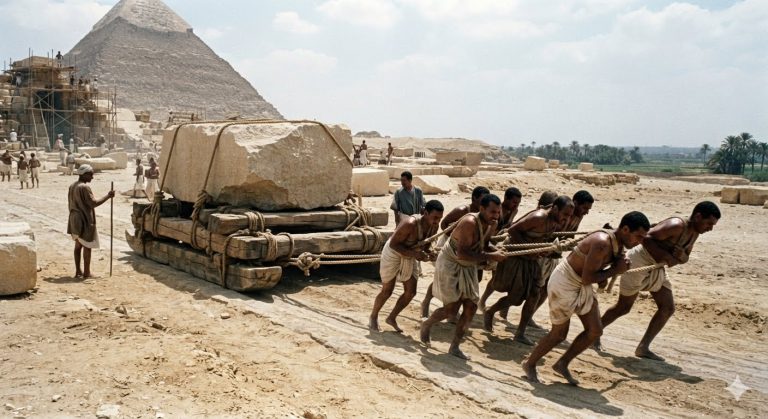
It’s theorized that the pulling of sledges was accomplished by way of two helpful techniques:
- by pouring water in front in front of the sledge (this would only work if the surface was hydrophilic clay or similar – not sand)
- and/or laying closely spaced wooden beams laid across the ground (sleepers) which could be repeatedly moved to the front as the stone travels along.
Many ancient quarries show evidence of “roads” leading out of them. These roads were cleared of obstacles and sometimes laid with a single course of dry-laid, unshaped and loosely fitted pieces of available stone to serve as a somewhat smooth surface for the sledge to glide over as it’s pulled with less friction. These quarry roads could be as long as 20 km (12.5 miles).
Failing quarry roads, some quarries, such as those in Peru, used steep mountainsides to slide the stones down, then somehow cross a river (no details), then somehow pulled up the mountainside to the upper levels of the mountain there (ref. Ollantaytambo).
Finishing/Dressing - Preliminary vs. Final?
Were the quarried stones partially finished in the quarry before or after extraction? Were they completely finished in the quarry before or after extraction? Or were they final-finished only at the construction site to achieve the desired fit and finish? The evidence actually seems to support a mixture of approaches – depending on different sites and the intended product.
Bosses or No Bosses?
In some instances the stones were final finished as they sat in the quarry – particularly obelisks. The risks with this approach is possible damage to the object during transport to the construction site. The advantage is that the same tools and worker expertise used to quarry could be used to finish the object without having these specialized masons available too at the construction site. This is especially true for granite. Finishing in the quarry also allowed the stone to be reduced to it’s lightest weight before transporting over distance.
The opposite approach was to create the stone larger than its intended size – leaving extra material (“bosses”) to compensate for any potential damage occurring during transport. Once at the construction site, the final cuts, fit and finish could be made. The negative to this approach is that the stone naturally weighs more during transport.
For soft stones, it appears the stones were at least roughed out to something close to their final form when in the quarry, sometimes including extra material (bosses) for further carving at the construction site (ref. Baalbek’s 27 podium stones of 350 tons each in various stages of final dressing for their front-face).
For hard stones, many seemed to be roughed to near final-finish and dimensions within the quarry. There are a few examples in Egypt where objects left in the quarries had already been inscribed there. he transport scenes from the causeway of Unas and the temple of Hatshepsut indicate that columns, architraves, and obelisks were dressed to their final shape in the quarry, excluding of course, polishing and inscribing the surface.
In the Inca quarries of Peru it’s theorized they used nothing more than hard stone pounding balls (hammerstones) to both rough and final-finish the granite and andesite.
Saws and Drills
Saws were also thought to be used to rough finish a surface. A copper saw blade (later iron), with or without teeth was used along with quartz sand to abrade-cut horizontally down into the stone. These blades would have to be very long in order to transverse the length or width of the object being cut. An example would be a sarcophagus lid being cut from the same block as the sarcophagus itself (which was apparently a normal practice). Saws were also thought to have been used to finely cut to adjoining stones to create a super-tight joint (such as the casing stones on a pyramid).
Copper tube drills, again with quartz sand, were thought to have been used to hollow-out sarcophagi before final finish chiseling and polishing. I’ll be posting a separate article on tube drilling at a later date.
Because of the high level of metal consumption in these abrasive approaches, it’s likely they were used only for special and rare cases.
Flatness
It’s thought that flatness was tested using a “true” surface such as a wooden board covered in red paint. As the board is drug across the face of the stone, the color would stick to the protruding areas which could then be chiseled further.
Straight rods or boards of 3 to 4 meters in length could have also been used, and they would have reached over several courses and blocks.
Yet, this begs the question: How were the boards guaranteed to be flat/true? By what process? By what measuring method & device?
Columns
While there is no information about how monolithic columns were cut & dressed, it’s thought they would have been dressed horizontally, but NOT have been rotated (like a crude lathe). There has been no evidence of rotation-sockets cut into the ends of the columns. The work would have been carried out in quarries since reliefs show them being transported in their near, final form – circular and with taper along the length. Some serious, careful and repeated measuring would have to be involved.
Issues With Orthodox Theories
There are several issues with the generally accepted orthodox theories for quarrying and transport:
- Copper and bronze chisels quickly become blunted and abrated as shown in Denys Stocks’ experiments, even in some of the soft stones. They are impossible to use for hard stone cutting.
- Too few of the quarries have been investigated in detail, so some evidence may have been missed.
- Dating of the quarries is problematic and the tool mark chronology of the Klemms needs refinement.
- In some instances, limestone from certain quarries was delivered up river. How was this done without powered barges to navigate against the current – regardless of the amount of the load? (From the Tura-Masara quarry area to Saqqara, for example. A distance of 10 to 12 kilometers (6 to 7.5 miles) and across the Nile.)
- Gallery quarries – How did the workers see their work in the back vertical space (behind the blocks), without smoke from an illuminating torch or fire choking them out and suffocating them? If the fire isn’t within a foot or two, it would be impossible for them to see any of their work area. Particularly with the deeper the work continued into the hillside and the light of the cavern’s opening was further away.
- While I didn’t get into many details above, some continuous quarry tool marks presumably by pickaxes are extremely long (4 inch to 40 inches long), indicating to archaeologists that said mark was accomplished with one stroke of the tool – most likely a pickaxe in this instance. However, in practice, that is essentially impossible. I hold firmly that NO hand tool can remove 4+ inches of stone in one strike/stroke (much less 1 m), unless it is powered and held steady to leave long, uninterrupted tracks in the stone. If the pickaxe is swung into the bedrock trench it certainly cannot penetrate more than a few inches, leaving a single mark. The next swing of that pickaxe may penetrate another few inches but there will be a new tool mark – not a continuation of that last stroke’s tool mark. A comment left on Per Storemyr’s pickaxe blog article of 2012 said essentially the same thing: “. . . if one hacks a trench with the pickaxe he is not able to cut more then 2-3 cm [0.75-1,2 in.] deep into the rock . . . In fact man cannot produce marks that are longer than this stretch; But what everyone can see on Switzerland or Egyptian quarry walls are marks which are til one mtr. long or more.” Storemyr’s response left a lot to be desired: “I totally disagree with you as concerns the Switzerland quarries. Using pickaxes to make trenches is beautifully documented in text and photos until the 1950s.” Yet he doesn’t note a single reference, AND he doesn’t address how a pickaxe in one swing can make a 1 meter long tool mark.
- Lack of focus on stone tools, flint in particular.
- Lack of actual quarry tool evidence: According to Harrell & Storemyr (2013), specific tool forms have long been debated because, with two [or three] exceptions noted in their article/paper, no recognizable metal tools have been recovered from the limestone and sandstone quarries themselves. Most have been found at the construction sites. Academics’ understanding is therefore based on tools found at the ancient construction sites where the stones were carved and dressed (pyramids, temples, tombs), as well as the aforementioned tool marks left on quarry walls.
- In addition, no actual tools have yet been found in Egypt’s Graeco-Roman limestone and sandstone quarries. Larger fragments of iron tools have been reported from two Roman quarries in Egypt for other rock types (anhydrite & gypsum).
- Actually, the question as to what kind of tools were used to cut the separation trenches and to lift the blocks from their beds has not been answered satisfactorily because of the contradiction between the tool marks left on the quarry walls and the tools actually found in ancient Egypt.
- Iron cannot consistently/efficiently cut hard stones of Mohs 7.
- Where did the abundance of dolerite balls come from? How were they formed in nature? If they are of such hardness, how were THEY cut into shapes to be chisels, mauls and pick-axe heads?
- The use of wooden wedges, wetted to swell has been shown to be a fiction in hard stone quarries.
- Some tool marks in the quarry faces found at Aswan could not have been made with stone. What metal could have been used? Nowadays the only metal used on the hard rocks is steel (tungsten steel, chromium steel or tungsten-carbide steel – – not just normal steel or iron) or diamond tools.
- Stone tools didn’t seem to have been used in quartzite quarries based on the visual evidence. As above, what metal tools could have possibly been used?
- With regards to pounding balls, reference the “NOVA Pyramid” documentary. In the VHS version of the show, Mark Lehner is shown pounding on granite for quite some time and not really making even a dent. Conveniently, this scene was edited out of the DVD version. How convenient. It is difficult to imagine how this method was applied to inclined, vertical, over even overhanging planes.
Modern Quarries
Modern methods used include:
- Diamond drills
- Diamond “wire” machines
- Diamond “chain” saws
- Diamond gang saws
- Diamond circular saws
- Hydraulic splitters
- Cranes
- Heavy-duty equipment (very large trucks, front-loaders, excavators)
- https://vimeo.com/814450393
- https://www.youtube.com/watch?v=WxD1mVg1O3s
- https://www.youtube.com/watch?v=NrtwBO_nyFA
- https://www.youtube.com/watch?v=YLz9DaSs3Sw
- https://www.youtube.com/watch?v=IYE8CB_OQIg 4:25 mark
- https://www.youtube.com/watch?v=RSejxl80CwU
- https://www.youtube.com/watch?v=VtMd1fR7wtI
- https://www.youtube.com/watch?v=rAUXGc0WvnI
Pointelle/Plug & Feather methodology:
Featured image of the Unfinished Obelisk in the quarry at Aswan, Egypt by Carlos Bustamante Restrepo on flickr via CC BY-NC-ND 2.0 Deed license.
Sources:
- “Ancient Egyptian Masonry: The Building Craft” – Somers Clarke and R. Engelbach (1930) [The 1990 unabridged republication is titled “Ancient Egyptian Construction and Architecture”]
- Inca Quarrying and Stonecutting – Jean-Pierre Protzen (1985) (PDF)
- The Quarrying Techniques of the Greek World – M. Waelkens, P. De Paepe, & L. Moens (1990)
- “Building in Egypt: Pharaonic Stone Masonry” – Dieter Arnold (1991)
- “Stein und Steinbruche im Alten Agypten” – Rosemarie Klemm & Dietrich D. Klemm (1993)
- Ancient Egyptian Quarries – Jordi Weinstock, Duke University (1999)
- Where Did They Get The Stone? (2000)
- Ancient Egyptian Quarries – Topographical and Petrological Survey of Ancient Egyptian Quarries – James A. Harrell and V. Max Brown (2001)
- “Experiments In Egyptian Archaeology – Stoneworking technology in Ancient Egypt” – Denys A. Stocks (2003)
- Research on the Archaeological Geology of Ancient Egypt, James A. Harrell (2007), expansion of his work of 2001
- QuarryScapes: ancient stone quarry landscapes in the Eastern Mediterranean – – Ancient Egyptian quarries – an illustrated overview – James A. Harrell and Per Storemyr (2009)
- Experimental archaeology: The traditional way of quarrying soapstone – Per Storemyr (2011)
- Building Stones – James A. Harrell, 2012 (PDF)
- With pickaxe into modern times: Quarrying of Bernese sansdstone – Per Storemyr (2012)
- Limestone and Sandstone Quarrying in Ancient Egypt: Tools, Methods, and Analogues – James A. Harrell & Per Storemyr (2013)
- Stone excavation with pickaxes in Ancient Egypt: Fact or Fiction? – Per Storemyr (2013)
- Ornamental Stones – James A. Harrell, 2013 (PDF)
- Ancient Egyptian Quarries: www.geology.utoledo.edu/research/archaeology/quarry.html (Wayback Machine link)
Featured image of the Unfinished Obelisk in the Aswan Quarry, Egypt by Carlos Bustamante Restrepo on flickr via CC BY-NC-ND 2.0 Deed license
Fair Use Notice:
– In good faith, this work contains fair use of copyrighted and non-copyrighted images from the public domain & the web for non-commercial & nonprofit educational purposes.
– This work is distributed free of charge.
– The author has neither monetized this work nor sought any profit from its distribution.
– Copyright disclaimer under section 107 of the copyright act 1976: Allowance is made for “Fair Use” for purposes such as criticism, comment, news reporting, teaching, scholarship, and research. Fair use is a use permitted by copyright statutes that might otherwise be infringing. Non-profit, educational or personal use tips the balance in favor of fair use.
– This work contains original work of commentary, education and critical analysis.
